
Astrakey uses many systems because no one fully describes the human being.
Why multiple systems?
No single system completely describes a person. Astrology sees time, place and celestial positions. Human Design emphasizes energy, decision and centers. Gene Keys works with archetypal maturation. Numerology condenses numbers from dates and names. BaZi reads the birth time via the Chinese columns of year, month, day and hour. The Enneagram describes recurring patterns of motivation and attention. Questionnaires bring everyday life, behavior and self-perception into it. Each of these perspectives is valuable in its own right, and each remains an excerpt. This is exactly where Astrakey comes in. Rather than committing to one system, Astrakey reads several together and examines what themes emerge across independent perspectives. This creates a profile that you can take more seriously without exaggerating a single symbolic language. The systems remain visible independently. Their shared value is shown where they point in the same direction.
- Every system is a perspective, not a complete picture. - Multiple independent perspectives are more resilient than one. - Astrakey reads systems together without exaggerating one.
Explore systems individually
In Astrakey you can get to know each system individually. You see what it says about you, what data it uses and what its limits are. This is deliberately kept transparent. A system should not appear mysterious, but rather understandable. Anyone who already knows astrology will find a familiar approach and can check how Astrakey categorizes the statements. Anyone who newly discovers the Human Design or Gene Keys will receive a calm, jargon-free introduction. Questionnaires and everyday systems also have their place here because they ground behavior and self-perception. This individual view is more than a reference work. It makes it clear what your overall profile will later consist of and takes away any arbitrariness from the method. You understand each building block before you see how they work together. For self-reflection, this multi-system view means that you don't tie a topic to a single interpretation, but rather see whether several perspectives point in the same direction before you take it seriously. All explanations are our own, editorially written texts that make a system understandable, not copied, protected original texts from the respective systems.
- Each perspective individually with contribution, data and limits. - Familiar access for experts, quiet introduction for newcomers. - Own editorial texts, no protected original texts.
Start with your own Astrakey profile.
Start for free, check the response and decide later whether you want to use more depth.
Why the overall profile is more reliable
The real added value arises where the systems are read together. Having multiple independent perspectives on the same topic creates a stronger profile motif. A single statement can impress, but it remains a clue. Only repetition across different systems makes a topic viable. Astrakey therefore does not check which system is right, but rather where systems meet. The reverse is just as important. When systems contradict each other, it is not a mistake, but rather an area of tension that often tells a lot about you. This double reading distinguishes a multi-system profile from a mere collection. You no longer get interpretations, but rather an organized view of which topics really recur and which only come from a single perspective.
- Agreement on systems makes a topic viable. - Contradiction becomes a field of tension, not a mistake. - Organized view instead of more individual interpretations.
System families against double counting
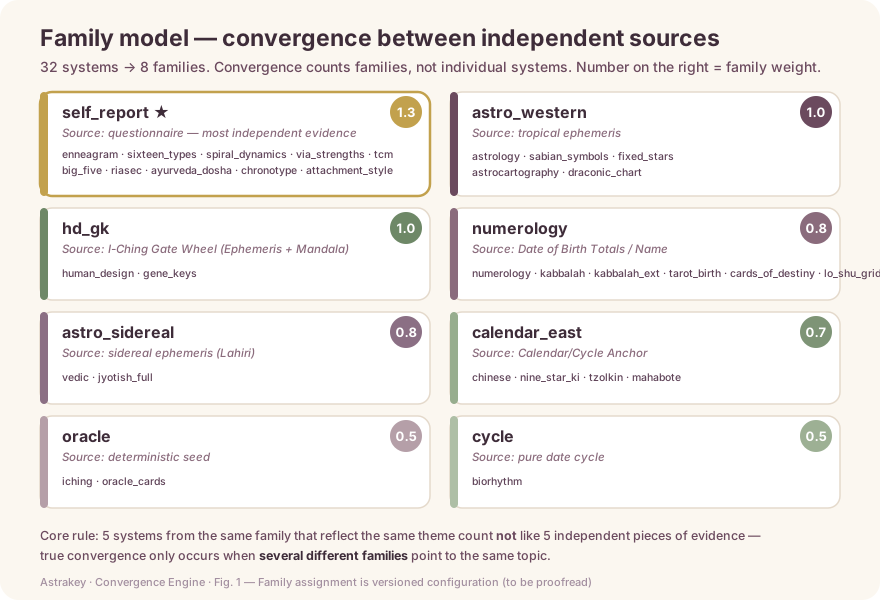
Many systems share related sources. Western astrology, Sabian degrees and astrocartography work from the same celestial data. Human Design and Gene Keys share a common wheel. Numerology and related number systems rely on date and name. If Astrakey were to count each of these systems as an independent vote, it would create a distorted impression of confirmation. Therefore, Astrakey groups related sources into system families. An echo within a family does not count as a second, independent confirmation. An issue only becomes truly strong when different families agree. This grouping is the reason why a multi-system profile is more reliable than simply adding up many tools. The convergence engine explains in detail how this works. On the systems side, the core is enough: relationships are recognized so that they don't count twice.
- Related systems often share the same raw source. - System families prevent an echo from counting twice. - Strong becomes an issue when different families agree.
All systems at a glance
Astrakey not only uses the well-known core systems. Behind your profile is a curated library of astrological, psychological, numerological, physical and symbolic perspectives. Each perspective has its own task. Some provide stable basic patterns, others show timing, relationships, body rhythms, values, calling or subtle nuances.
You don't need to know these systems. The system library shows you what each system can contribute, what data it needs and what its limits are. This means that many individual voices do not become a mess, but rather a calmly ordered map.
You can find all systems under /de/systems/library/.
- Astrakey does not collect systems to claim more. - Each system has data requirements, roles and limits. - The library leads from the single perspective back to the multi-system profile.
From a single system to your own profile
Both paths lead together. You can start with a system that interests you and work your way through your overall profile from there. Or you start with the profile and look at which systems support a certain topic. In both cases the logic remains the same: Astrakey not only shows you what a system says, but also how it can be classified in interaction. Your profile is not a rigid label. It marks which statements are reliable, which should be read carefully and where systems make different sides of you visible. The free entry is enough to experience this logic for yourself. You see the first core topics, recognize the first system evidence and understand how a coherent profile is created from multiple perspectives.
- Entry via a system or via the overall profile. - Every statement with evidence, certainty and possible tension. - Free entry is enough to experience the logic yourself.
How the method works in the background
Frequently asked questions
Which systems does Astrakey connect?
Among other things, astrology, Human Design, Gene Keys, numerology, BaZi, Enneagram and questionnaires. Other systems are added as additional perspectives.
Can I view a single system separately?
Yes. Each system can be explored as its own system profile, with its contribution, data and limitations.
Why not just use the best system?
Because each system only shows a section. Only the agreement of several independent systems makes a topic viable.
Does Astrakey replace the individual systems?
No. Astrakey uses them as perspectives and classifies them. You can continue to view each system on its own.
What happens when systems contradict each other?
A contradiction is not a mistake. Astrakey shows it as a field of tension that is often particularly revealing.
Do I need the same data for all systems?
No. Some systems use time and place of birth, others only use date or name, others use self-disclosure. Astrakey shows what is needed for what.
Does this mean Astrakey is making objective statements about me?
No. Astrakey shows reliable patterns with their evidence and highlights uncertainty. It remains an opportunity for reflection.
Start with your own Astrakey profile.
Start for free, check the response and decide later whether you want to use more depth.