
You don't have to like math to understand this.
Convergence instead of addition
Many tools give you a horoscope, a Human-Design-Bodygraph or a numerology number. Some even put several systems next to each other and call it an overall picture. Astrakey asks one level deeper. It is not enough to show many systems. What matters is which themes emerge across multiple systems and how independent these clues really are. This is exactly what the convergence engine does. It does not simply add systems together, because a sum would treat each vote equally, even if multiple votes have the same origin. Instead, Astrakey examines whether different, independent perspectives support the same topic. Only then does a topic become strong. A simple example makes the difference tangible. Astrology and astrocartography use the same celestial data. If they both say the same thing, it is not a second, independent confirmation, but the same source heard twice. That's exactly what Astrakey doesn't count twice. This difference between addition and convergence is small in word and big in effect. It separates a beautiful collection from a resilient profile.
- Showing many systems is not the same as checking convergence. - A sum treats dependent votes as independent ones. - A topic only becomes strong through independent agreement.
System families prevent double counting
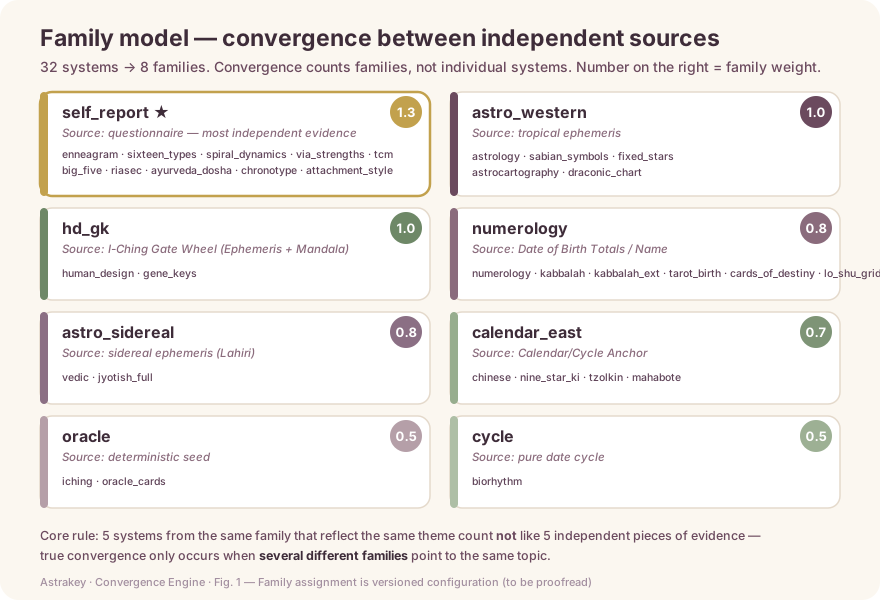
Many systems share the same raw source. Western astrology, Sabian degrees, fixed stars and astrocartography use related celestial data. Human Design and Gene Keys share the common wheel. Numerology and related number systems work from date or name. If Astrakey were to count each of these systems as independent confirmation, a distorted impression would be created. Three systems from the same source then acted like three independent witnesses, even though they essentially repeat the same statement. That's why the convergence engine bundles related systems into families. An echo within a family does not count as a second, independent voice. An issue only becomes truly strong when different families agree. This grouping is the ultimate defense against an artificially inflated endorsement. It does not devalue any system. Each system retains its technical independence and its own language. The family only pools the common raw source so that a shared origin does not count twice. It is the reason why a multi-system profile is more reliable than simply adding as many tools as possible.
- Related systems often share a common raw source. - An echo in the same family does not count as a second vote. - Only approval from different families makes a topic strong.
Start with your own Astrakey profile.
Start for free, check the response and decide later whether you want to use more depth.
Damping instead of sum
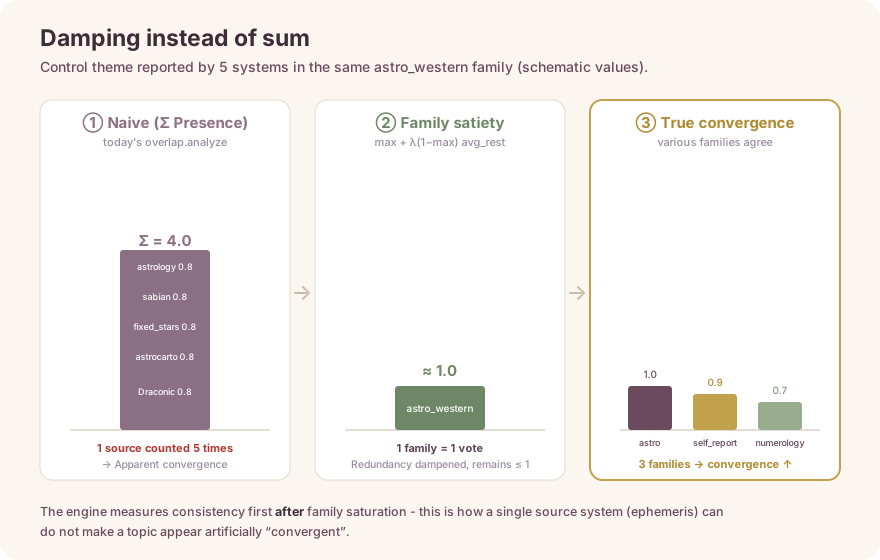
Once relatedness is recognized, Astrakey deliberately treats similar signals with caution. Instead of fully counting every additional vote from the same family, the engine attenuates their contribution. This sounds technical, but there is a simple idea behind it. If five sources from the same family say the same thing, it is not five times as convincing as a single independent confirmation. It is essentially a statement, repeated five times. A naive sum would artificially inflate such repetitions and make weak statements seem loud. Attenuation prevents this. It ensures that a topic does not become strong because it often comes from the same place, but rather because it is confirmed from different places. This keeps the strength of a statement honest. It reflects real, independent agreement and not the mere volume of a single symbolic language.
- Repetition from a family does not equal confirmation. - Cushioning prevents artificially inflated strength. - Strength reflects independent agreement, not volume.
Four sizes, neatly separated
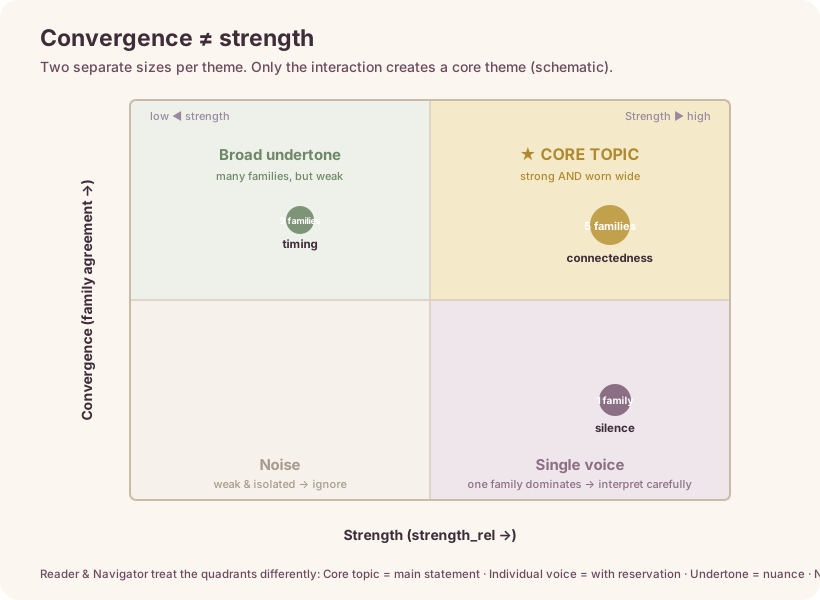
Astrakey does not describe a topic with a single number, but deliberately separates four variables. These four are internal plausibility measures that Astrakey uses to classify its own statements, not statistical quality criteria like in a psychological test. Strength shows how present a topic is in your profile. Convergence shows how many independent families support this issue. Security shows how reliable your entries and the calculation are, for example whether there is an exact time of birth. Voltage shows where two poles are active at the same time. This separation is the real reason for explainability. A theme can be strong but not very convergent; then it is present but only supported from one corner. A topic may be highly convergent but have low certainty because an important input is missing. By not conflating these dimensions into a single impression, Astrakey allows you to read each statement in a differentiated way. You not only see that something belongs to you, but also how secure, how broadly supported and how exciting it is.
- Strength, convergence, security and tension remain separate. - Strong without convergence means present, but only from one corner. - You read each statement differentiated instead of as a number.
Contradiction becomes a field of tension
What happens when systems contradict each other? In many offers, a contradiction is hidden or smoothed over because it seems uncomfortable. Astrakey takes the opposite approach. A contradiction is not a mistake, but often the most interesting part of your profile. When one system emphasizes withdrawal and another emphasizes visibility, this rarely describes a mistake, but rather a real inner tension that many people are familiar with. Astrakey makes such areas visible as areas of tension instead of smoothing them out. A tension field is an axis with two poles active at the same time, not a yes or no. These fields in particular often tell more about you than any clear statement, because they describe where something is moving within you. This attitude is at the core of the engine. It treats complexity not as a problem to be solved, but as information to be taken seriously.
- A contradiction is not a mistake, but a field of tension. - Two poles at the same time instead of a forced either/or. - Areas of tension often tell more than clear statements.
From the funnel to the core topic
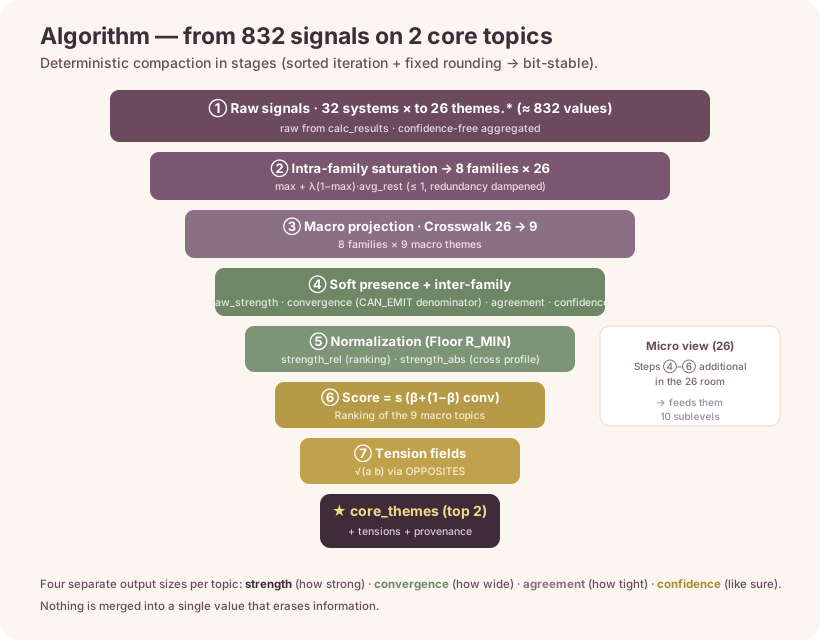
You can think of the convergence engine as a funnel that compacts in multiple stages. At the beginning there are many raw signals that each system calculates from your information. These raw signals are translated into theme signals, i.e. into comparable topics instead of system-specific technical terms. Then related sources are bundled into system families so that echoes do not count twice. Ultimately, a few well-supported core themes remain, each with their strength, their convergence, their security and possible tensions. Many individual voices become an orderly, readable view. You don't have to understand the math behind it. A clear language appears in the app: your core topics, your quiet secondary topics, your productive tensions and the systems that support these statements. If you wish, you can look deeper and understand why Astrakey makes a statement. The response remains warm, the basis remains verifiable.
- Raw signals, theme signals, system families, core topics. - Many voices become an organized, readable view. - You can trace every statement back to its supporting systems.
What you get out of it
In the end, what matters is what this engine means to you. You get a profile that you can trust more because you can check its origins. You will recognize which of your topics are broadly based and which you should read more carefully. You understand where two sides of you are active at the same time, instead of dismissing them as contradictions. And you are protected from a typical risk: that a single, dramatic-sounding statement shapes you more than it should. The convergence engine explains not only what is in your profile, but why a statement should be read stronger, weaker or cautiously. In everyday life, this means: You can use a broadly supported core topic as a calm anchor for an upcoming reflection or decision, while you consciously give lighter weight to a topic that is only narrowly supported. This is exactly where the difference lies between a nice interpretation and a comprehensible multi-system profile. You can use the free entry to experience this difference yourself, on your own initial core topics.
- A profile whose origin you can check. - Protection against a loud individual statement influencing you. - Not just what is in your profile, but why.
How the method works in the background
Frequently asked questions
What is the Convergence Engine?
It is the methodological layer of Astrakey that checks which topics emerge across multiple independent systems and consolidates robust core topics from them.
Is the convergence engine an AI?
No. It is a deterministic computing layer. AI later formulates the interpretation, but does not decide which systems agree.
Why doesn't Astrakey simply add up systems?
Because many systems use related data sources. A naive sum would treat dependent voices like independent ones and inflate statements.
What are system families?
System families bundle systems with a common raw source. An echo within a family does not count as a second, independent confirmation.
What do strength, convergence, security and tension mean?
Strength shows the presence of a theme, convergence the number of independent families, security the resilience of the inputs, tension two poles active at the same time.
Can I see where a core theme comes from?
Yes. Astrakey can show which systems and families support a topic. This is part of explainability.
Does the engine make Astrakey objective?
No. It makes Astrakey understandable, not absolute. Every statement remains an offer of reflection with visible uncertainty.
What happens when systems are contradictory?
A contradiction is not smoothed over, but presented as a field of tension, i.e. as an axis with two poles active at the same time.
Start with your own Astrakey profile.
Start for free, check the response and decide later whether you want to use more depth.